Industry
Why Funeral Homes Must Advertise for AI, Not Just Google
Families now ask ChatGPT and Perplexity for funeral-home recommendations. If you're not running ads and feeding data to LLMs, you're invisible.
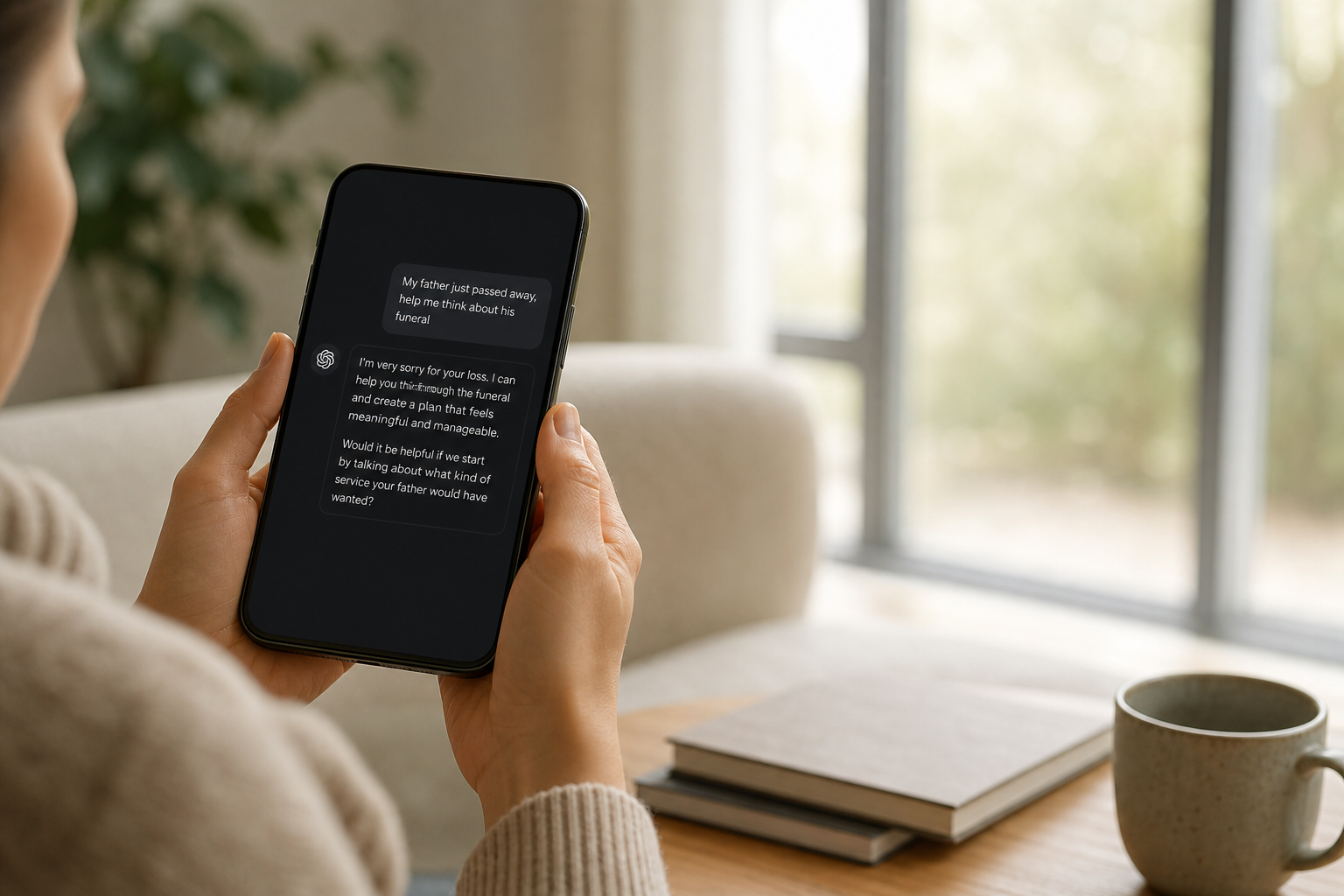
For twenty years the answer was simple: get a website, claim your Google Business listing, maybe run a few search ads during busy months. That playbook still works, but it's no longer enough.
Families planning a funeral today don't only search Google. They ask ChatGPT, Perplexity, Claude or whichever assistant is already open on their phone. They say "find me a funeral home near Bruges that handles repatriation" or "which funeral director in Lille has good reviews," and the AI gives them three names. If yours isn't one of them, the conversation is over before you knew it started.
This shift changes the rules. Your website still matters, but now you also need to be visible to language models and agent platforms that don't crawl the web the way Google does. That means structured data, active advertising, fresh signals and the kind of operational consistency most small funeral homes simply don't have time to maintain.
LLMs don't rank like search engines
Google ranks pages. It looks at links, keywords, domain age and hundreds of other signals, then shows ten blue links. You know where you stand. You can see your position, track your competitors, adjust your content.
Large language models work differently. They synthesize answers from training data, live search results, curated databases and sometimes paid placements. When a family asks for a recommendation, the model doesn't return a ranked list. It returns a narrative with two or three names embedded in natural sentences.
There is no page two. There is no "scroll down to see more options." If the model doesn't mention you in its first reply, you've lost the lead. And unlike SEO, you can't reverse-engineer the algorithm because the weights change with every model update and the training corpus is opaque.
The only reliable way to appear in these answers is to make sure your business shows up in the datasets and APIs these models query: review platforms, local directories, advertising networks, and increasingly, direct partnerships between AI companies and service aggregators.
Most funeral homes lack the time and the toolkit
Running effective ads used to mean writing a few text lines and picking some keywords. Now it means managing campaigns across Google, Meta, maybe TikTok, syncing your inventory of services, keeping your business details identical across a dozen platforms, monitoring which phrases trigger your ads in AI-generated answers, and testing creative that works in a feed, a chat interface and a voice readout.
It's a full-time job. And most funeral directors already work sixty-hour weeks. You're answering calls at midnight, coordinating with hospitals and churches, sitting with families who need your full attention. The idea that you should also become a performance marketer, a data analyst and an AI-platform specialist is absurd.
Even if you hire help, the skills are hard to find. The agencies that understand funeral service rarely understand programmatic ads or LLM optimization. The digital agencies that understand AI don't know how to talk about embalming, repatriation or grief support without sounding like they're selling shoes.
So most funeral homes do nothing, or they do the minimum: a static Facebook page, a Google listing that hasn't been updated since 2021, maybe a website built by a nephew. That was borderline acceptable five years ago. Today it means you're invisible to a growing share of families who never pick up the phone until they've already decided where to call.
Advertising is now infrastructure, not promotion
There's an old-fashioned stigma around funeral advertising. It feels unseemly, too commercial, like you're capitalizing on grief. Many directors still believe that word of mouth and reputation should be enough.
But advertising in 2025 isn't about convincing families to hold a funeral. It's about making sure they can find you when they've already decided they need help. It's infrastructure. If your details aren't flowing into the platforms families actually use, you don't exist in their moment of need.
Think of it like having a phone number in the directory, or a sign on your building. Those aren't promotional tactics. They're basic accessibility. Running ads, maintaining schema markup, feeding your service catalogue into APIs: these are the new versions of being listed. The families who find you this way aren't being "sold to." They're being helped to connect with a professional they were already looking for.
And the families who use AI tools aren't a niche. They're not all young or tech-obsessed. Expectations have shifted across every age group. A seventy-year-old daughter managing her father's funeral from another city will absolutely ask her phone for help. If you're not in that answer, someone else is.
The workload problem won't solve itself
Some funeral home software vendors have started adding "digital marketing" modules. They'll auto-post to Facebook or send you an SEO checklist. That's helpful, but it doesn't address the core problem: you still have to do the work, and the work keeps expanding.
Every new platform is another login, another dashboard, another set of guidelines. Every AI model that launches is another corpus you need to feed. Every review site is another profile to monitor. The administrative burden doesn't shrink. It compounds.
This is why growth has become harder even as demand holds steady. The operational surface area has exploded. Families expect you to be reachable by text, email, chat and voice. They expect accurate information on every platform. They expect fast responses even outside business hours. And now they expect you to show up in AI-generated recommendations, too.
You can hire more staff, but good people are scarce and expensive. You can work longer hours, but there's a limit. Or you can recognize that some of this work, maybe most of it, can be handled by systems that don't get tired, don't forget to update your Meta pixel, and don't need to learn a new AI platform every six months.
What this means in practice
If you're running a funeral home today, you need three things working simultaneously: accurate, structured data about your services flowing to every major platform; active advertising that puts you in front of families and into the APIs that LLMs query; and enough operational capacity to actually answer the phone and serve families well when they do find you.
Most directors can manage one, maybe two of those. All three at once, while also doing the work that actually matters, caring for families and coordinating services, is not realistic.
The solution isn't to become a marketer. It's to treat marketing, data management and communication as operational problems that deserve the same kind of systematic support you'd give to any other part of your business. That might mean software, outsourcing, or automation. What it can't mean is pretending the old playbook still works, or that reputation alone will carry you through the next five years.
Lethra handles intake calls, family communication and ad campaigns so funeral directors can focus on the work that requires a human being. If the new reality of AI-driven discovery feels like one more thing you don't have time for, that's because it is.
Also available in