

Sharing with the family
The Family Portal gives a family their own view of their case: what is arranged, when it is happening, and the documents that concern them. It exists to stop the same three questions arriving by phone on a Tuesday afternoon.
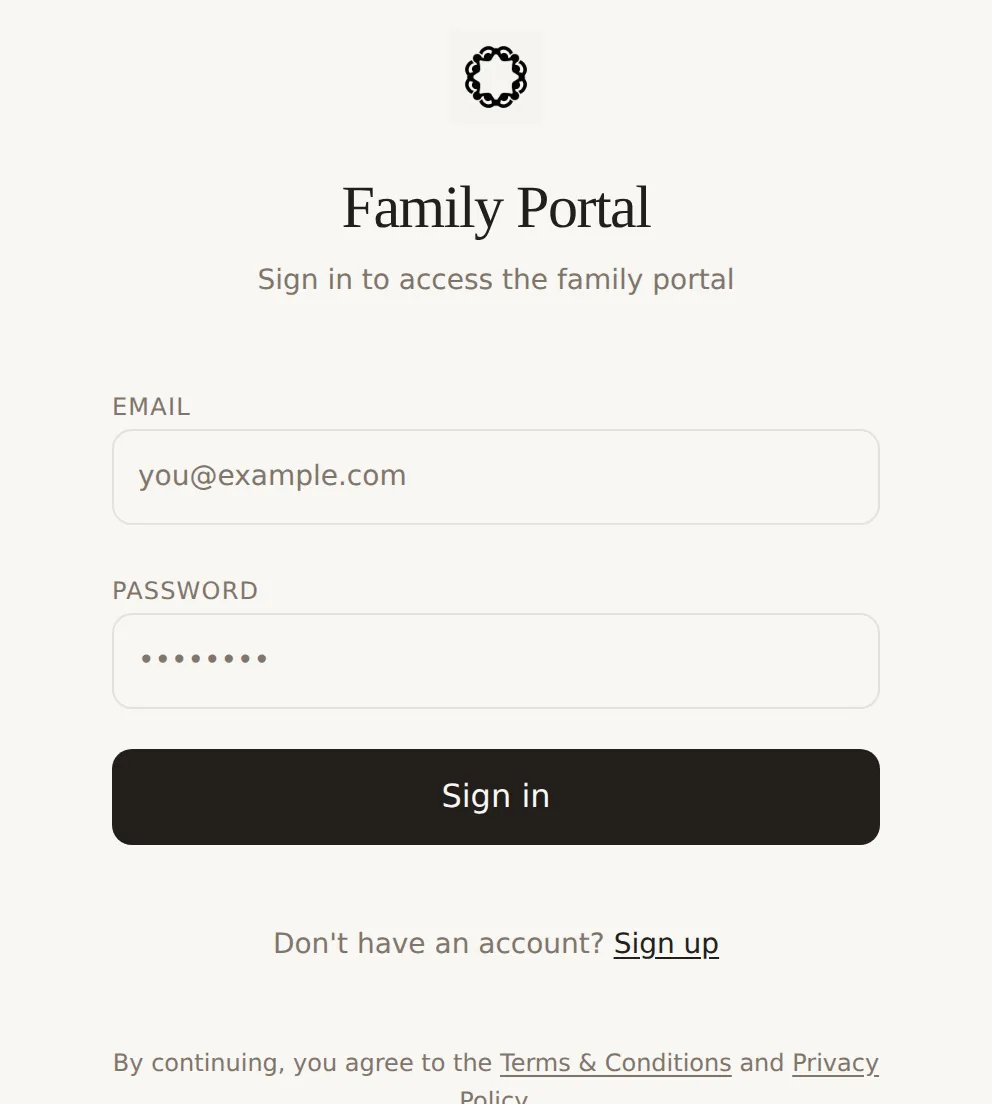
It is a separate door from the staff sign-in, and it is deliberately narrow. A family sees their case and nothing else.
Inviting a family
Section titled “Inviting a family”From the case, use Invite Family. You can either send the invite by email, or copy the link and send it yourself if you would rather it came inside a message you have already written.
The invite goes to the contact email on the case, which is why that field matters so much when you are creating a case.
The family member then creates their own account with their own password.
You can invite more than one person. Relatives can hold different roles, such as Executor or Trusted contact, which is useful when the person handling the paperwork is not the person you speak to most.
What the family sees
Section titled “What the family sees”Once signed in, a family member lands on Home, with their case listed. If they have been invited to more than one, they choose between them.
Inside a case there are three tabs.
| Tab | What is on it |
|---|---|
| Details | The deceased’s details and the primary contact. |
| Documents | Files you have shared, and anything they upload. |
| Schedule | The services, with dates and places. |
There is also Where things stand, a plain summary of the current stage, so a family can see progress without having to interpret anything.
What the family cannot see
Section titled “What the family cannot see”This is worth knowing precisely, because it is the question every funeral director asks first.
They never see:
- Your other cases, or any other family
- Your inbox, or any conversation you have not sent to them
- Your internal notes
- Anything in Growth, Leads, Ads or Calls
A family sees the Details, Documents and Schedule of their own case. That is the whole of it.
What the family can do
Section titled “What the family can do”See the schedule. Services with dates and places, so the details are somewhere they can check at midnight without ringing you.
Read documents you have shared.
Upload files. Photos for a slideshow, a scanned document you asked for, a eulogy. This is the part that saves the most time, because it replaces the “can you email that again, it did not come through” loop.
Plan ahead. The portal also carries planning, where someone can record their own wishes in a guided conversation, and where a relative can be brought in to help with a plan. That is separate from an active case.
Getting the most out of it
Section titled “Getting the most out of it”- Invite early. The portal is most useful in the first days, when the family has the most questions and you have the least time.
- Add services as soon as they are fixed. The Schedule tab is only reassuring when it is current, and an empty one prompts a phone call.
- Tell them what it is for. One sentence when you send the invite, saying they can see the arrangements and upload photos there, gets far more families using it than an invite arriving with no explanation.
Where to go next
Section titled “Where to go next”That is the whole of getting started. The remaining modules, scheduling in depth, documents and templates, growth and the eLys integration for Flanders, are being written next.
If you are stuck in the meantime, ask the Assistant inside Lethra, or reply to any email from us.